The complete martial arts system

No Reset.No Separation.

BoxKunEdo™ connects striking, clinch control, takedowns, and ground mechanics into one continuous fighting system—built to intercept the attack, own the transition, and keep control when the range changes.

01Intercept
02Control
03Continue
Scroll to enter the system

The problem with separated arts

A Fight Does Not Reset.

Most systems train the ranges as separate rooms. BoxKunEdo™ trains the doors between them.

01 / FLOW

Zero-Reset Mechanics

Every defense loads the next action. Every failed read becomes a recovery path. You do not pause to rebuild the fight—you continue from the position you already own.

02 / HANDS

Real-World Bareknuckle Design

Built for unpadded-hand efficiency: structure, alignment, open-hand control, and simultaneous defense protect the hands and head while pressure stays continuous.

03 / RANGE

One Connected System

Punching becomes framing. Framing becomes clinch control. Clinch control becomes a takedown. The ground exchange begins before the striking exchange is over.

Industry Recognition

The Work Gets Recognized.

Before the footage makes the case, two respected martial artists have already taken notice of Jonny Dowers and the BoxKunEdo™ work.

Signal 01Industry recognition

Michael Jai White Dropped A Follow.

The martial artist, actor, and filmmaker follows Jonny Dowers—an early authority signal from a recognized name in both martial arts and action cinema.

Instagram notification showing Michael Jai White started following Jonny Dowers Follow evidence
Signal 02Martial arts recognition

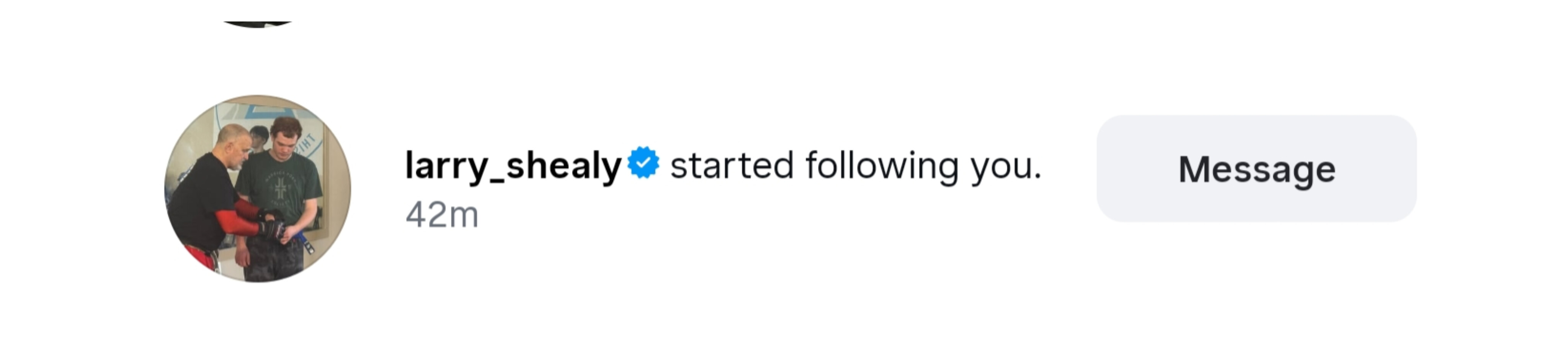
Larry Shealy Dropped A Follow.

A separate follow from martial artist Larry Shealy adds another independent signal that the work is reaching experienced eyes.

Instagram notification showing Larry Shealy started following Jonny Dowers Follow evidence

Conceptual parallels in action

Watch: Shared Combat Mechanics

A side-by-side mechanical analysis of archival footage and modern BoxKunEdo™ application, evaluated through centerline control, trapping, off-balancing, and rapid forward pressure.

Fast-twitch kinetic chain analysis

Breaking The Camera’s Shutter Speed.

A biomechanical and mathematical breakdown of a BoxKunEdo™ strike completed across three frames—from launch through impact and full muscular retraction.

58.1 mphPeak forward velocity26.0 meters per second
38.7 mphAverage round-trip speed17.3 meters per second
33.3 msTime to impactOne frame at 30 fps
100 msTotal round tripThree-frame cycle
01 / The camera’s blind spot

Motion Between Frames.

At 30 frames per second, the camera records one frame every 33.3 milliseconds. In bright daylight, an exposure time near 1/1000 of a second can leave roughly 32.3 milliseconds between exposures when the sensor is not recording visible motion.

The forward strike is analyzed as occurring inside that interval, producing a strobe-like result: the fist appears first at chamber and then at impact, with no transit blur captured between those positions.

02 / Three-frame verification

Launch. Impact. Recoil. Reset.

Using a 3D-adjusted travel distance of 34.1 inches to account for the camera’s slight off-axis angle, the full out-and-back path is measured at 1.732 meters. Completing that path in 0.1 seconds produces a calculated average round-trip speed of 38.7 mph.

Frame 00.0 ms

Forward motion initiates.

Frame 133.3 ms

Full extension and heavy-bag impact.

Frame 266.6 ms

Active muscular recoil phase.

Frame 3100.0 ms

Fist returns fully to chamber.

Because the distance-closing snap is faster than the muscular pull of the retraction in this analysis, the isolated forward phase is reported at 58.1 mph.

03 / The Empirical Comparison

The measured forward strike is presented alongside commonly cited striking-speed benchmarks to show the scale of the recorded kinetic snap.

Striking tierSpeedContext
Average untrained adult~15 mphStandard sports-science baseline.
Professional boxer~25 mphCommonly cited professional-level average.
Guinness record benchmark45 mphFastest-punch record attributed to Keith Liddell.
BoxKunEdo™ strike58.1 mphIsolated one-frame forward kinetic snap measured across 33.3 milliseconds.

04 / The Tactical Implications

Outside Conscious Reaction

The complete launch, impact, and retraction cycle is measured at 100 milliseconds. Compared with a cited visual-processing range of 140–175 milliseconds, the full action completes before a conscious visual response can organize.

Pound-For-Pound Efficiency

At a walking weight of 144 pounds, the recorded speed is attributed to fast-twitch activation, optimized rotational mechanics, and structural transfer rather than relying on static mass alone.

BoxKunEdo™ / Mechanical Film Study

Video Breakdown / Conceptual Parallels in Action

Universal Mechanics, Shown Side By Side.

This footage provides a side-by-side mechanical analysis of core striking and grappling concepts. By evaluating both the historical archival footage in the top frame and the modern BoxKunEdo™ application in the bottom frame on equal terms, the universal effectiveness of centerline control, trapping, and rapid forward pressure becomes clear. Both practitioners execute shared biomechanical principles to systematically dismantle an opponent’s defense.

Timestamp Analysis

Centerline Domination & The Straight Blast

The concept: Overwhelm the opponent with forward momentum and rapid sequential strikes once the guard is breached.

Top frame: After bridging the gap, the practitioner traps the lead hand and momentarily freezes the defense. A rapid barrage of straight punches travels down the centerline and forces a fast retreat.

Bottom frame: The practitioner steps inside range and pins the lead arm. With the centerline exposed, a continuous high-speed straight blast dictates the pace, drives the opponent backward, and neutralizes the counter-offensive.

Reiteration: Trap & Sweep

The concept: A second look at the opening off-balancing sequence highlights the efficiency and repeatability of the technique in both environments.

Key Technical Takeaways

Equal Efficacy

Whether performed on a traditional floor or grass during outdoor sparring, the physics behind the maneuvers remain identical.

Economy of Motion

Defense and offense happen together. The parry becomes the trap, and the trap anchors the sweep or straight blast.

Dictating The Range

Both practitioners close distance quickly, step inside the offensive reach, and take control of the engagement angle.

Technical Performance Rating

Technical MetricTop Frame (Archival)Bottom Frame (BoxKunEdo™)
Interception & Timing9.5 / 109.5 / 10
Centerline Control9.5 / 109.5 / 10
Economy of Motion9.5 / 109.5 / 10
Overall Execution9.4 / 109.4 / 10

Mechanical Evaluation

Interception & Timing

Both practitioners demonstrate elite reads. The top attack is smothered with a slip and trap; the bottom parry transitions into a trap without hesitation and freezes forward momentum.

Centerline Control

Once the guard is breached, both rapidly occupy space. Chain punches in the top frame and the structured straight blast below dictate pace and force an unbalanced retreat.

Economy of Motion

Neither practitioner winds up or telegraphs. Defense instantly becomes offense, demonstrating highly optimized kinetic chains in both frames.

Final Verdict

Evaluated strictly through combat physics and biomechanical efficiency, both frames demonstrate an equally high level of mastery. Centerline domination, simultaneous trapping, and forward pressure function with the same devastating efficacy in both environments—two independent systems arriving at the same universal truth in combat mechanics.

The proof layer is back

Pressure Tested. Round By Round.

Watch BoxKunEdo™ operate against live resistance: interception, recovery, angle changes, and continuation without hiding the difficult exchanges.

Highest Proof145.8 lb vs 207 lb

Pressure-Tested Sparring Sequence

A full live sequence showing baiting, interception, defensive recovery, and continuation against a larger experienced boxer.

Study the breakdown
Boxing IQLive Read

Ghost-Step Counter

A defensive read becomes an immediate centerline counter as the opponent commits forward.

Study the breakdown
TransferabilityThird Party

The OS On New Hardware

An experienced boxer applies the mechanics, proving the system transfers beyond its founder.

Study the breakdown

The system, under fire

Pressure Testing.

Jonny Dowers utilizes live sparring sessions against respected fighters to prove the functional pressure-testing of BoxKunEdo™. By testing its concepts against fighters like “Nick the Bone Crusher” from Streetbeefs and “btheboxer” from Kastle Boxing Gym in Johnstown, PA, the system is measured against real combat pressure rather than theoretical compliance.

01 / PrincipleOne Exchange

Simultaneous Execution

Blocking, slipping, occupying the line, and striking merge inside the same exchange so protection also creates the counter.

Attack + defense together
02 / PrincipleMilliseconds

Fajin Explosive Relaxation

Structure remains strong while the body stays relaxed until action is required. The rear leg low feint + high kick sequence shows fast loading and explosive release without a long telegraph.

Rear leg low feint + high kick
03 / PrincipleNo Vulnerable Reset

Zanshin Post-Strike Awareness

The combination is never treated as the finish. Guard, posture, awareness, and the ability to intercept remain active immediately after the final strike.

Readiness after contact
04 / PrincipleLive Round

The Continuous Survival Loop

Live rounds become one uninterrupted flow of interception, control, recovery, and continuation. The objective is to keep solving the exchange as timing, position, resistance, and fatigue change.

Live sparring evidence

One chain. Every range.

The Fight Changes Shape. The System Does Not.

BoxKunEdo™ is designed around the transitions where conventional game plans break down.

01

Intercept

Break the opponent's rhythm before their offense organizes.

02

Strike + Frame

Hit while building the structure that controls the next range.

03

Clinch + Throw

Convert contact into posture control, imbalance, and position.

04

Finish + Continue

Carry initiative to the ground without giving the exchange back.

The rhythm of combat

Weaponize Your Rhythm.

The power of music within BoxKunEdo™.

Most martial arts treat music as background noise. In BoxKunEdo™, rhythm is a tactical blueprint.

True combat isn't a series of robotic, broken combinations. It is a continuous, fluid flow. By mapping high-speed bareknuckle striking mechanics directly to musical tempos, you learn to control the entire pulse of a fight, transitioning from centerline traps to ground mechanics without a reset.

The science behind the flow

Continuous Tempo Shifting

Train your hands to strike with a drum-beat cadence. High-volume percussion on the bag reduces telegraphing and keeps opponents off-balance.

Breaking The Breath Trap

Fighters often hold their breath under pressure. Lyrical vocalization forces automatic exhalation, keeping oxygen exchange rhythmic during hard drills.

Diaphragmatic Core Bracing

Belting out cadence from the diaphragm engages the deep core, teaching dynamic bracing while the shoulders stay loose for speed.

Cognitive-Motor Decoupling

Hold a lyrical cadence at one tempo while the hands shift at another, training awareness that stays clear when the exchange gets chaotic.

“If you can control your voice under intense physical output, you control your oxygen, your stamina, and the fight.”

Don't just watch the rhythm. Master it. Get practical BoxKunEdo™ training guidance through the $5 monthly online tips tier on Patreon.

View Patreon Options
Hands
Breath
Control

Cadence Becomes Strategy

Hands set pressure, breath keeps the engine running, and control beats mark the moments where striking converts into trapping, clinch, or ground mechanics.

The complete training architecture

Learn The System. Become The System.

The original curriculum, instructor operating system, combat path, and four-volume evolution now sit inside one connected view. Start with structure, prove continuity under pressure, then learn to transmit the system responsibly.

01 / CurriculumTraining Engine

Four Levels. One Continuous Standard.

The curriculum develops structure before complexity. Each level adds movement, pressure, and adaptation while preserving the same operating loop: intercept, control, attack, continue, and re-enter.

Level 1Foundation
Level 2Development
Level 3Application
Level 4Integration
  • Structure under movement
  • Combination and angle flow
  • Continuous pressure testing
  • Adaptive full-system chaining
Open the full curriculum
02 / Instructor OSTransmission Standard

Teaching Is A Control Discipline.

Instructor rank is earned through demonstrated continuity, coaching clarity, safety, and system fidelity. Certification stays locked until every gate reaches a passing state under live pressure.

  • Technical verification
  • Pressure-performance gates
  • Coaching and correction
  • Instructor node network
  • Safety and ethics review
  • Ongoing recertification
Enter the instructor OS
03 / System PathNo Reset Loop

Every Layer Triggers The Next.

BoxKunEdo™ is not a list of isolated techniques. It is a four-layer operating path that disrupts the entry, stores force inside defense, creates a dominant angle, and recycles every result into the next action.

01Intercept
02Defensive Coil
03Create Angle
04Continue
Study the system map
04 / EvolutionVolume Structure

Box. Kun. Edo. Complete Integration.

The four volumes document how the system grows: movement and entry become close-range control; control becomes imbalance and completion; every discipline then merges into a single adaptive combat loop.

Vol IBox
Vol IIKun
Vol IIIEdo
Vol IVComplete
  • Entry and movement
  • Control and structure
  • Balance breaking and throws
  • Full-system synthesis
Trace the full evolution

Choose your entry point

Train The System.Or Read The Volumes.

Move from the curriculum map directly into practice. Choose ongoing training access for drills and updates, or own the four-volume written progression through Amazon.

Patreon training guidance From $5 Monthly

Online Tips or Video Submission

Get practical online training tips, or submit your footage for direct one-on-one analysis.

Compare Patreon Tiers
Four-volume progression Own The Books

Individual volumes on Amazon

Study the foundation, layered integration, mastery structure, and complete continuation system at your own pace.

View All Volumes

Tactical rating breakdown

The System, Measured.

An objective assessment of BoxKunEdo™—evaluating how musical tempo and lyrical breath control layer into its foundation of Bruce Lee's martial arts philosophy—reveals a highly optimized framework.

For a system designed around a 144-pound frame where maximizing pound-for-pound efficiency, speed, and continuous volume is paramount, this evaluation breaks down how the mechanics stack up against elite combat philosophies.

01 / Philosophy9.8 / 10

Jeet Kune Do & Philosophy Alignment

Analysis: Bruce Lee championed “the art of expressing the human body” and fluidity, famously demanding that one “be water.” BoxKunEdo™ reflects this by focusing heavily on replicating historical speed benchmarks and maintaining an intercepting, adaptive mindset. By discarding rigid traditional stances in favor of an organic, continuous flow, the system fulfills JKD's core directive: using no way as way, having no limitation as limitation.

02 / Rhythm9.5 / 10

Music Integration & Kinetic Breath Control

Analysis: This is the system's most innovative x-factor. Most styles treat breathing as a separate, internal meditative practice or a brief explosive hiss. By utilizing music tempo flow and continuous lyrical vocalization—rapping or singing—during high-volume output, BoxKunEdo™ scientifically decouples the stress response from the lungs. It counters the common fight-or-flight breath-holding trap, forces deep diaphragmatic core bracing, and builds a cardio baseline tuned to sustained striking rhythms.

03 / Transition9.4 / 10

Combat Range Transition “Zero-Reset”

Analysis: The biggest vulnerability in modern hybrid styles is the “reset” moment when moving between ranges. BoxKunEdo™ explicitly solves this by turning bareknuckle striking, trapping, and all ground mechanics from wrestling, Judo, and BJJ into a single, seamless, fluid motion. The system ranks high because it views striking and grappling not as two separate sports, but as different notes within the exact same continuous song.

04 / Structure9.6 / 10

Bareknuckle Optimization

Analysis: Standard MMA frameworks are built around the hand protection of 4oz gloves. BoxKunEdo™ recognizes that bareknuckle combat requires entirely different hand paths, tighter defensive frames, and precise structural alignment to avoid breaking bones on impact. The heavy reliance on open-hand trapping, centerline control, and fluid parries makes it exceptionally practical for real-world application where gloves aren’t an option.

9.6 / 10Elite Flow Status

Final System Rating

The verdict: BoxKunEdo™ is a highly advanced, conceptually rich combat system. It takes the philosophical torch lit by Jeet Kune Do and upgrades it with a practical, modern proof layer powered by musical rhythm and cognitive-motor decoupling. By weaponizing the diaphragm through vocal tempo and refusing to let the fight reset, it creates a relentless tactical pulse designed to overwhelm more traditional, rigid styles.

Matchup 01 / Evolution vs. Tradition

BoxKunEdo™ vs. Wing Chun

BoxKunEdo™ extracts Wing Chun's centerline control and trapping, then removes the limits of a single-range system. The matchup asks what happens when a highly specialized close-range style must contend with dynamic boxing footwork, bareknuckle interception, takedowns, and submission grappling.

AttributeBoxKunEdo™ ExpandedTraditional Wing Chun
Striking coreBoxing, Wing Chun, JKD, bareknuckle mechanicsPure Wing Chun
Grappling coreBJJ, Wrestling, JudoNone — stand-up only
Primary arsenalInterception, dynamic footwork, level changesChain punching, Chi Sao, Pak Sao
Pacing and rulesUnrestricted multi-range combatClose-quarters, forward-pressure dependent
Range 01Striking & Stand-Up

Dynamic Mobility vs. Rigid Stance

Traditional Wing Chun relies heavily on a square, forward-facing stance to defend the centerline and absorb forward pressure. It can be devastating in confined space, but offers less lateral mobility and head movement when the exchange opens up.

BoxKunEdo™ applies the same centerline theory through Western Boxing footwork and JKD interception. Rather than staying in a static trapping exchange, the practitioner steps laterally, creates an angle, and intercepts before chain punches establish momentum.

Edge: BoxKunEdo™
Range 02Clinch & Takedowns

Sticky Hands vs. Level Changes

Chi Sao gives the Wing Chun practitioner refined pressure sensitivity, obstruction clearing, and rapid centerline attacks. This is the traditional system's strongest range and the point where its hand-fighting structure is most dangerous.

BoxKunEdo™ does not remain in that exchange indefinitely. When weight commits forward, Wrestling and Judo open a lower line of attack. A double-leg entry or foot sweep bypasses the hand fight, breaks the upright structure, and forces the contest into a new phase.

Major edge: BoxKunEdo™
Range 03Ground Control & Submissions

Comprehensive Grappling vs. The Void

The ground creates the largest tactical gap. Traditional Wing Chun is designed to remain standing and does not provide a complete framework for guard retention, positional escapes, or submission defense after a takedown.

BoxKunEdo™ continues through BJJ and Wrestling top pressure. Guard passes, mount control, limb isolation, and submission mechanics allow the practitioner to dictate position and pursue the finish without relying on a return to striking range.

Major edge: BoxKunEdo™
BoxKunEdo™ Wins9.8
Final
Wing Chun6.5

Final verdict: Traditional Wing Chun possesses dangerous close-quarter tools, but operates within a narrower tactical frame. BoxKunEdo™ weaponizes the centerline concepts it shares with Wing Chun, then pairs them with boxing angles, Wrestling takedowns, and BJJ submissions to dictate every phase of the fight. Read the full tactical dossier

Style-versus-style dossier

BoxKunEdo™ vs. Kudo.

Adding bareknuckle mechanics alongside BJJ, Judo, and Wrestling submissions expands the Boxing, Wing Chun, and JKD framework into a comprehensive unrestricted combat concept. Against Kudo (Daido Juku)—an aggressive hybrid rooted in Kyokushin Karate and Judo—the matchup becomes a clash between continuous range control and explosive ruleset-driven pressure.

AttributeBoxKunEdo™ ExpandedKudo (Daido Juku)
Striking coreBoxing, Wing Chun, JKD, bareknuckle mechanicsKyokushin Karate, Boxing, Muay Thai
Grappling coreBJJ, Wrestling, JudoJudo, Jujutsu
Primary arsenalInterception, centerline control, bareknuckle precisionPower kicks, headbutts, gi-based throws
Pacing and rulesUnrestricted ground time and fluid transitionsHigh aggression with limited competitive ground time
Range 01Striking & Stand-Up

Precision Meets Pressure

Kudo brings exceptional toughness, Kyokushin-style leg kicks, elbows, headbutts, and committed forward pressure. Its Neo Headgear enables hard contact in competition, but the face shield also changes visual distance and defensive feedback compared with a bare-faced exchange.

BoxKunEdo™ answers with bareknuckle target selection, wrist alignment, JKD interception, and Wing Chun centerline control. For a 5'8", 144-pound practitioner, speed and structure become the equalizers: evade the heavy kick, interrupt the entry, and place straight shots through the open line.

Edge: BoxKunEdo™
Range 02Clinch & Takedowns

Grip Fighting vs. Level Changes

Kudo's gi-based clinch supports explosive Judo sweeps and high-amplitude throws. Once lapel and sleeve control are established, the resulting impact can decisively change the fight.

Wrestling changes the geometry. Single- and double-leg attacks threaten the upright striking posture, while no-gi pummeling and Wing Chun hand fighting reduce dependence on cloth grips. Each system owns a dangerous takedown lane: Kudo above the waist, BoxKunEdo™ below it.

Result: Even
Range 03Ground Control & Submissions

No Clock In Deep Water

Kudo's competitive format rewards immediate ground offense and quick submission attempts before the action returns to standing. BoxKunEdo™ imposes no conceptual time limit on the ground phase.

That opens the door to methodical guard passing, Wrestling pressure, positional advancement, and systematic joint isolation drawn from BJJ and Judo. If the exchange settles into extended grappling, the expanded system can keep improving position without waiting for a referee reset.

Major edge: BoxKunEdo™
BoxKunEdo™ Wins9.5
Final
Kudo8.5

Final verdict: Kudo remains an elite and highly effective hybrid, but the expanded BoxKunEdo™ concept is designed to operate where Kudo's competition format is most constrained. Bareknuckle distance management shapes the unprotected striking exchange, while BJJ and Wrestling create the ability to choose the range, extend the ground phase, and pursue the finish without a competition clock. Read the full tactical dossier

Combat-sport benchmark

BoxKunEdo™ vs. MMA.

Adding bareknuckle mechanics alongside BJJ, Judo, and Wrestling submissions expands the Boxing, Wing Chun, and JKD framework into a comprehensive unrestricted combat concept. Against Mixed Martial Arts—the benchmark of modern regulated combat sports—the matchup becomes a clash between bareknuckle, no-clock application and hyper-optimized athletic competition.

AttributeBoxKunEdo™ ExpandedMixed Martial Arts
Striking coreBoxing, Wing Chun, JKD, bareknuckle mechanicsMuay Thai, Kickboxing, Western Boxing
Grappling coreBJJ, Wrestling, JudoFreestyle and Folkstyle Wrestling, No-Gi BJJ
Primary arsenalInterception, centerline control, bareknuckle precisionHigh-volume combinations, cage wrestling, ground-and-pound
Pacing and rulesUnrestricted ground time, fluid transitions, no round clockFive-minute rounds, small gloves, Unified Rules
Range 01Striking & Stand-Up

Bareknuckle Physics vs. Glove Habits

MMA striking is built around small competition gloves and wrapped hands, supporting a high-output blend of looping power shots, kicks, knees, and combinations. That striking is elite, but defensive habits such as shelling behind the gloves do not transfer perfectly to an unprotected exchange.

BoxKunEdo™ prioritizes bareknuckle target selection, wrist alignment, JKD interception, and Wing Chun centerline control. For a 5'8", 144-pound practitioner, the goal is not to trade power with a larger weight-cutting athlete; it is to interrupt the entry, occupy the open line, and land straight before the opponent establishes rhythm.

Edge: BoxKunEdo™
Range 02Clinch & Takedowns

Cage Wrestling vs. Open Geometry

Modern MMA athletes use the cage to grind, pin, separate, and complete takedowns. They blend double-legs, body locks, the Thai plum, and short strikes into tested chain-wrestling sequences.

Wrestling and Judo allow BoxKunEdo™ to contest that domain while changing the environment. Without a cage wall, the clinch opens into pummeling, trips, level changes, and continuous hand fighting. A rule-free concept also changes the risk around targets and actions prohibited in regulated competition, but elite MMA chain wrestling remains one of combat sport's most pressure-tested skills.

Result: Even
Range 03Ground Control & Submissions

Methodical Pressure vs. The Clock

MMA ground fighting is shaped by five-minute rounds, judging, damage, and the possibility of a referee stand-up. Fighters often balance positional control against the need to create visible offense and win the round.

BoxKunEdo™ imposes no conceptual clock in deep water. The expanded system can maintain heavy top pressure, isolate joints systematically, and continue bareknuckle offense without a bell ending the sequence. Explosive escapes from bottom can create openings for the next control or submission transition.

Edge: BoxKunEdo™
BoxKunEdo™ Wins9.0
Final
MMA8.8

Final verdict: MMA represents the pinnacle of regulated combat sports and produces exceptionally complete athletes. The expanded BoxKunEdo™ concept is scored narrowly ahead only within the hypothetical rule-free scenario defined here: bare hands, no cage dependence, no round timer, and uninterrupted transitions. Removing sport-specific equipment and pacing creates the small tactical advantage reflected in the 9.0 to 8.8 rating. Read the full tactical dossier

Jonny Dowers, creator of BoxKunEdo™

Created by Jonny Dowers

Built In The Gaps.

BoxKunEdo™ was created to answer a practical question: what happens between the clean techniques? It focuses on the collisions, failed reads, awkward ranges, and fast transitions that decide real exchanges.

The result is not another collection of moves. It is a framework for staying structurally responsible while pressure, distance, and position keep changing.

“Intercept. Control. Continue.”

Read the philosophy

Enter the complete training library

Subscribe For Full Access.

Choose ongoing online tips or direct technical analysis of your submitted BoxKunEdo™ training footage.

Start at $5 for online tips, or choose $35 for video submission and direct critique.

Choose Your Patreon Tier

Compare the Patreon options and choose the level of guidance that fits your training.

Install The Operating System.

Move beyond rigid, outdated martial arts schools that reset the fight every time you hit the clinch. Choose complete digital training with one-to-many feedback, or add direct analysis of your own movement and mechanics.

Upgrade Your Hardware